
I remember trying to figure out the real room dimensions I needed for my first golf simulator. Every site gave different numbers.
A few said 10 feet. Some said 15. Some threw metric conversions at me that didn’t match anything else. The truth is, the right dimensions depend on your height, your swing, and the launch monitor you plan to use.
After testing camera units, radar units, and ceiling mounted systems across multiple setups, here is the clearest and most accurate breakdown you can use for your own build.
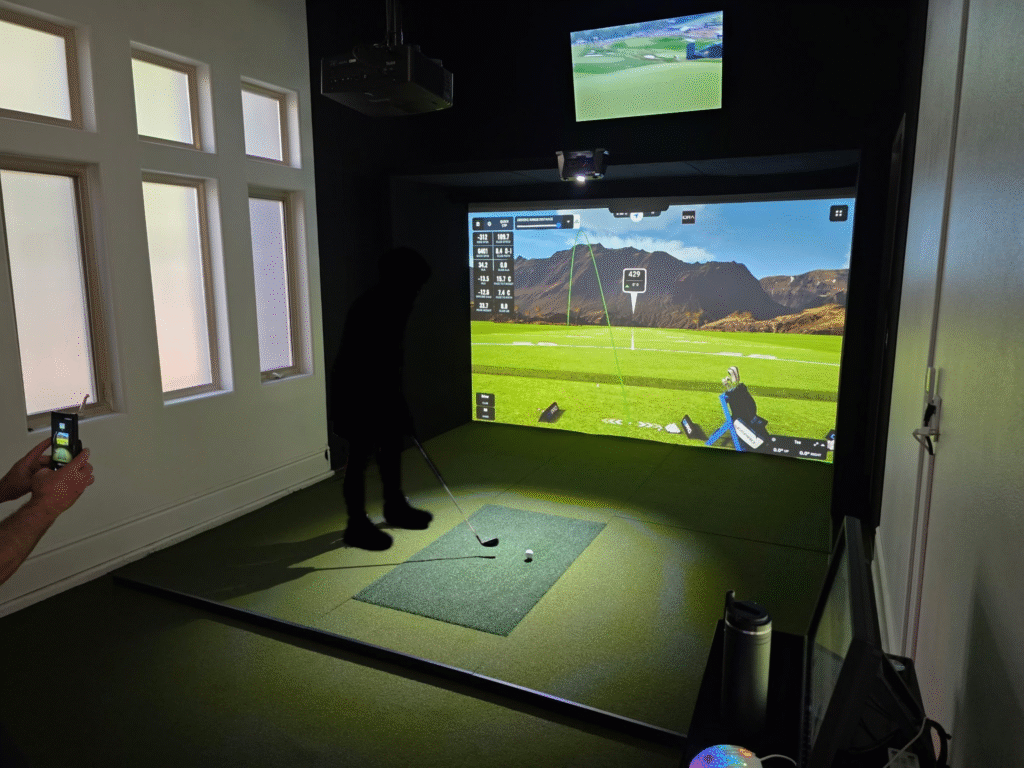
The Minimum Golf Simulator Room Dimensions
The smallest room I’ve seen someone pull off comfortably sits around 10 feet wide, 15 feet deep, and 9 feet high. That’s the absolute threshold. Taller players, aggressive driver swings, or dual-handed setups start feeling tight fast.
If you prefer metric numbers, the minimum generally translates to 2.5 meters high, 4 meters wide, and 5 meters in depth. Camera systems like SkyTrak Plus can work inside those limits. Radar systems require more depth to track the full ball flight.
The Ideal Room Size for Most Indoor Golf Builds
Most people end up needing 12 to 15 feet of width and 16 to 20 feet of depth. Ceiling height feels best at 10 feet or more, especially if you swing a driver with a higher arc.
In metric terms, a comfortable build sits at 3 meters high, 4.5 to 5 meters wide, and 6 meters deep. This allows space for centered hitting, projector throw distance, and free movement behind the mat.
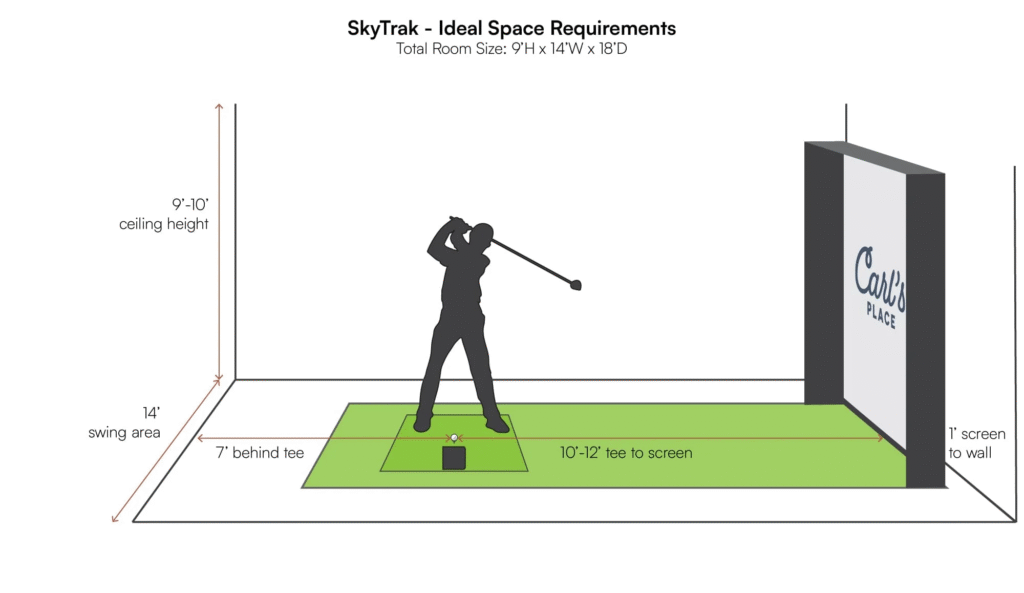
Tee-to-Screen Distance
This number confuses people more than anything, but it’s simple. The tee should be positioned 10 to 12 feet from the impact screen. Ten feet works for smaller rooms. Twelve feet absorbs more energy and lowers bounce-back when you step into a driver.
I’ve tested setups below 10 feet, and it never feels right. The ball rebounds harder, your launch monitor gets finicky, and the depth of field looks compressed.
Ceiling Height: The Most Important Measurement
Nine feet is the bare minimum for most players. Ten feet feels safer. Anything above that brings comfort immediately. I’m 6 feet tall, and even I feel the difference between 9 and 10 when I take a full-speed driver swing.
Here’s the clean breakdown:
• Minimum height: 9 feet
• Comfortable height: 10 feet
• Ideal height: anything above 10 feet
Tall players or players with an upright swing path should lean toward 10 or more.
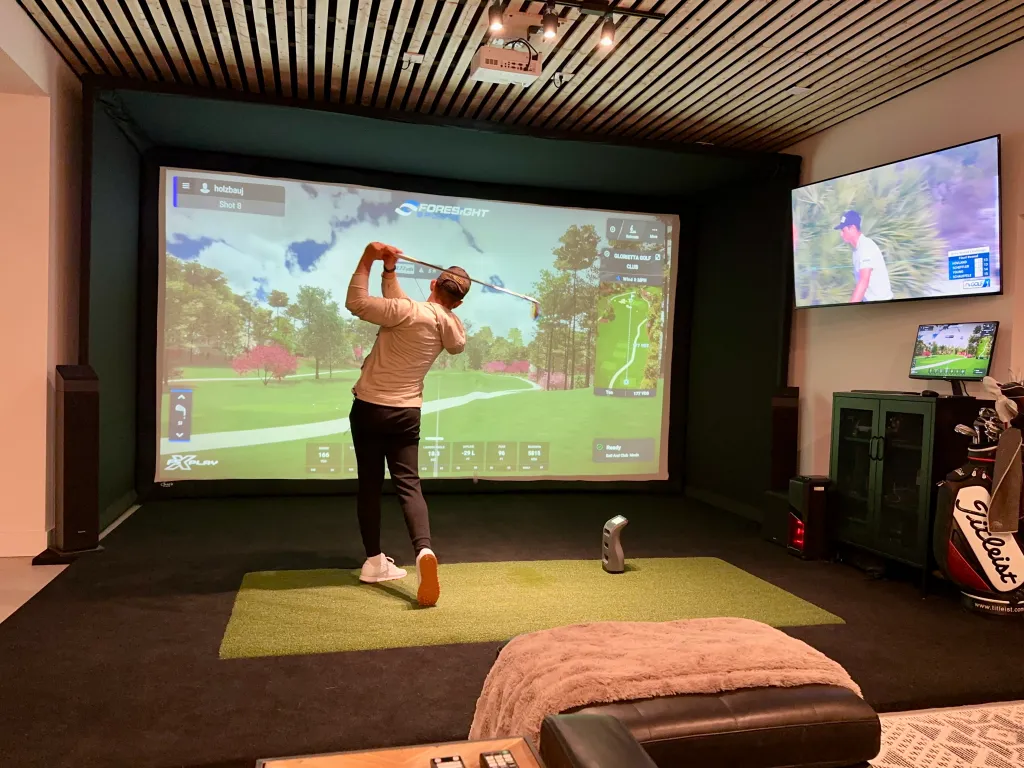
Width Requirements
Width determines whether you can swing centered or off-center.
• 10 feet wide is the minimum
• 12 to 15 feet wide is the sweet spot
• 14 to 15 feet lets you center the mat for right and left-handed golfers
If you plan to host guests or run a dual-handed bay, I recommend at least 14 feet.
Depth Requirements
Depth depends heavily on your launch monitor. Radar units require the most space. Camera systems need less.
• Minimum depth: 15 feet
• Comfortable depth: 16 to 18 feet
• Ideal depth: 20 feet
This leaves space behind the tee, space for the launch monitor, and proper tee-to-screen distance.
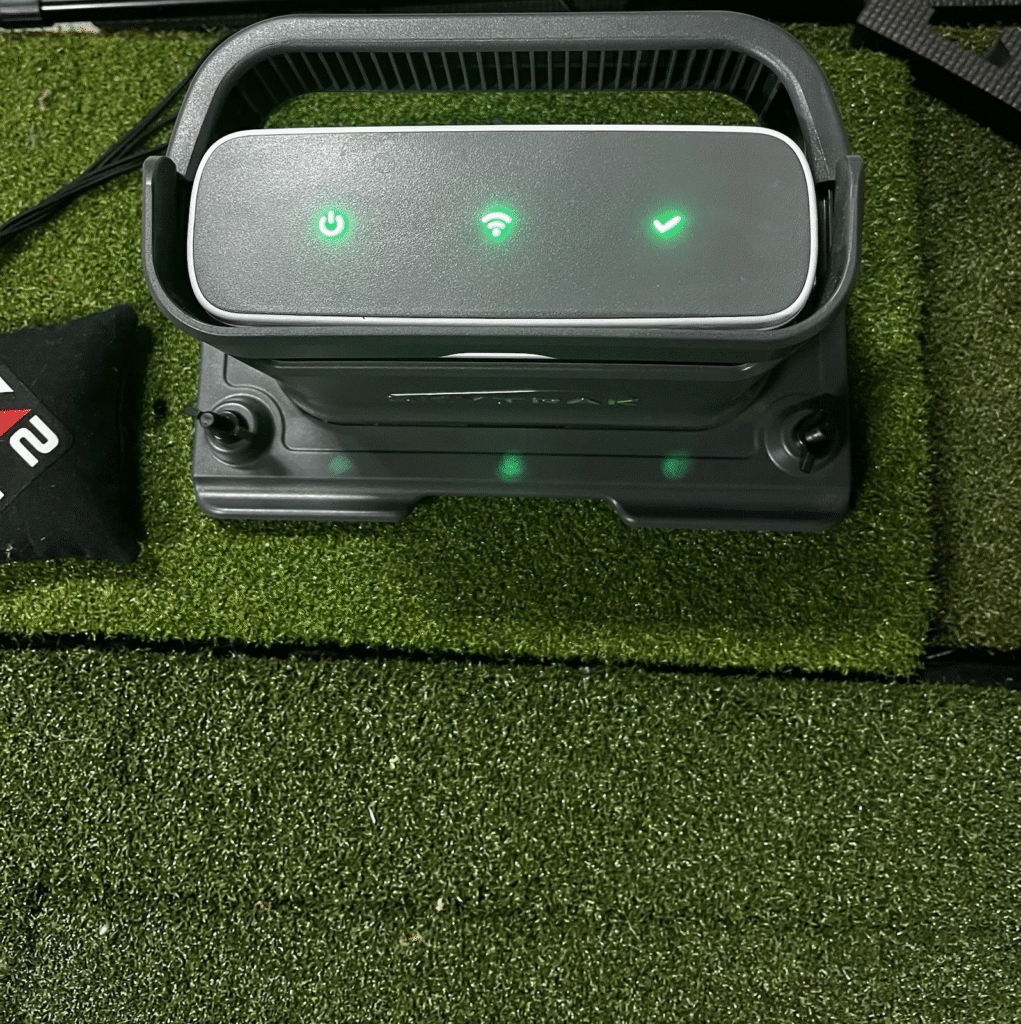
Room Dimensions by Launch Monitor
Not every system needs the same spacing. After rotating through SkyTrak Plus, GC3, Bushnell Launch Pro, Trackman iO, and GCQuad, here is what each one realistically needs.
SkyTrak Plus
The SkyTrak Plus works well in 10 feet of width, 12 feet of depth, and 9 feet of ceiling height. It is a camera-based unit, so it doesn’t need the extra depth radar requires. Fourteen to 15 feet of width feels even better for centered hitting.
Garmin R50
You need more depth for the radar based Garmin R50. 16 to 18 feet feels right. Height should be 9 or 10 feet. Width stays similar at 10 to 12 feet. If you have the option, go closer to 20 feet of total depth to unlock smoother ball-flight tracking.
Bushnell Launch Pro and GC3
These two feel best in 10 to 12 feet of width, 16 feet of depth, and 9 to 10 feet of height. They track measured ball data extremely well, and the depth requirement is less demanding than radar.
GCQuad
GCQuad thrives in premium spaces. Twelve to 14 feet of width gives you clean centered hitting. Sixteen to 20 feet of depth keeps the feel balanced. Ten feet or more in height makes a noticeable difference when swinging with speed.
Trackman iO
The Trackman recommends 15 feet wide, 10 feet high, and 18 feet deep for a full bay. Trackman iO performs best with at least 9.4 feet of ceiling height, ideally closer to 10. Tee placement should be around 10 feet from the screen. For dual-handed use, the full 15-foot width recommendation matters.
Foresight Falcon
Falcon only needs 9 to 10 feet of ceiling height since it mounts overhead, but width should be at least 12 to 14 feet to avoid shadowing. Depth follows the same range as GCQuad: 16 to 20 feet. It is the cleanest ceiling mounted option in tight and wide rooms.

Layout Flow That Actually Works
You only need to follow a simple layout rule to avoid mistakes. Place the mat 10 to 12 feet from the screen. Leave 2 to 4 feet behind the mat for movement and launch monitor placement. Then make sure nothing overhead blocks your swing. That’s it. Simple and effective.
If you want a dual-purpose room, you can dedicate separate zones for hitting, seating, media, and storage. A 14 to 15-foot width makes this far easier.
Metric Reference for International Builders
If your room is measured in meters, here are the conversions you can use:
• Minimum: 2.5 m height x 4 m width x 5 m depth
• Comfortable: 3 m height x 4.5 m width x 6 m depth
• Ideal: 3+ m height x 5 m width x 6+ m depth
These numbers match Google’s AI Overviews and the top-ranking pages. Your build will feel identical to the US measurements.
Final Thoughts
Building an indoor golf simulator starts with getting the room dimensions right. Once you understand the spacing, choosing a launch monitor becomes easier, and the entire build makes more sense.
After testing camera systems, radar units, and overhead mounts, the room always matters more than the tech. Give yourself clear swing space, enough depth for tracking, and a ceiling height that lets you swing without hesitation.
If you follow the measurements in this guide, every launch monitor on the market will work the way it was designed to, and your simulator will feel like a real hitting bay instead of a cramped corner.